Why Arts-Based Programs?
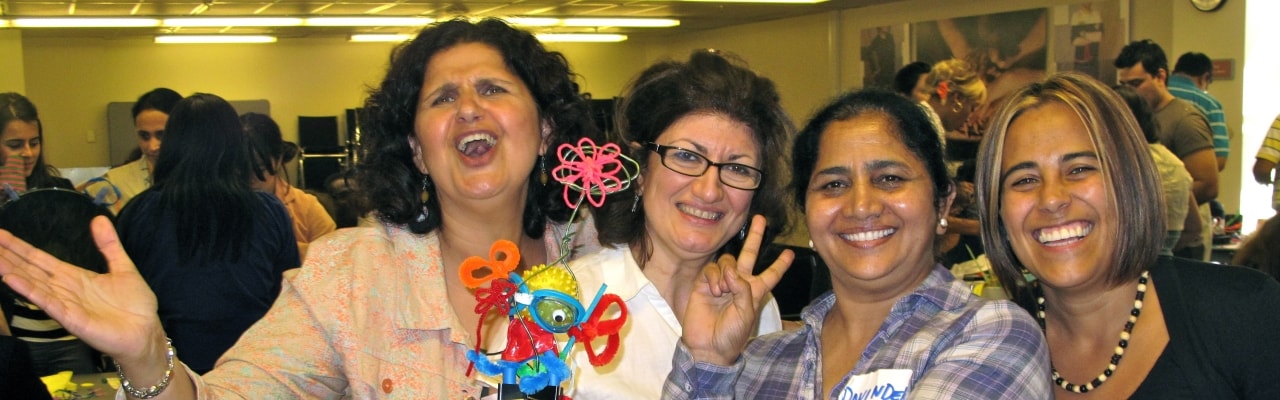
Over the years we've encountered a little skepticism; some of our clients initially wondered if arts-based programs were relevant to their corporate environment, and if the HR team, management or staff members would really benefit from a day of creating unique works of art, music or performance. The answer is a resounding YES! And what's best is that our workshops require no artistic skills.
Unlike many sports or physical-activity team building or leadership programs, art is something anyone can do (even if we don't think we can). Making art is about seeing new possibilities. Possibilities are opportunities. We all need to hone our skill of finding new opportunities.
It also isn't something that most executives do every day, so it provides a neutral backdrop, perhaps a little outside of the workaday comfort zone – an ideal learning environment. And in today's economy, we are required to step into the unknown and operate in arenas that are not altogether familiar.
Arts-based programs help participants to:
- Discover qualities of spontaneity and humour – in themselves and others
- Build trust within teams and organizations
- Strengthen bonds with other team members
- Combine thoughts and ideas in new ways
- Recognize and expand intuitive abilities – without fear or judgment
- Step outside their usual comfort zone
- Focus on listening and communicating
- Learn about styles of communication
- Adapt quickly and confidently to change
- Examine issues from new perspectives
- Work collaboratively and effectively
- Think inventively
- Learn by doing
- Apply these experiential skills to work scenarios
What's Integrative Thinking and Why Does It Matter?
Arts-based programs allow participants to break away from linear thinking to a more integrated, left-brain, right-brain thought process. Think of it as a form of 'cross-training'; you will be warming up the muscles you need for creatively solving problems of any kind.
Integrative thinking combines critical thinking with creative thinking, and allows people to synthesize multiple perspectives. It requires people to break out of the silos of their own areas of expertise – marketing, finance, HR, whatever it is – and collaborate across disciplines with people who may speak a different kind of language and operate from a different kind of culture. What could be more valuable in today's shifting, global markets?
Don't Just Take Our Word For It... Here's what some experts say:
"Today's fast-changing global markets place increased pressure on companies of every kind to continuously create new products, services, and competitive strategies if they are to survive and prosper. I've come to realize that firms in any industry do better, all else being equal, when they are able to harness creativity."
Teresa M. Amabile
Edsel Bryant Ford Professor of Business
Administration
Unit Head, Entrepreneurial Management
Harvard School of Business
"Solving these complex problems and making robust decisions in a turbulent business environment requires integrative thinking skills. In addition to having knowledge of specific functional disciplines, we believe that business leaders need to develop the ability to create mental linkages to understand the disciplines together."
Roger Martin
Dean
University of Toronto, Joseph L. Rotman School of Management
"The era of 'left brain' dominance, and the Information Age that it engendered, are giving way to a new world in which 'right brain' qualities – artistry, inventiveness, empathy, meaning and big-picture thinking – predominate."
Dan Pink, Author